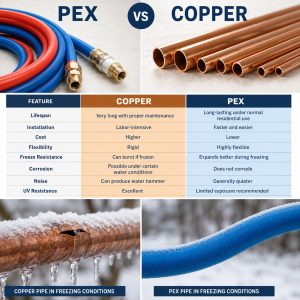


PEX is flexible plastic tubing used in water supply and heating systems. It can replace copper or rigid plastic piping in many applications, although local codes and the requirements of each project determine where it may be installed.
Because PEX bends around corners and can be supplied in long coils, a plumbing system can often be assembled with fewer fittings. That makes it particularly useful for renovations and for running new water lines through spaces where rigid pipe would be difficult to install.
What Is PEX in Plumbing?
PEX stands for cross-linked polyethylene. It is most commonly used to carry hot and cold water to sinks, showers, toilets, washing machines, and other fixtures.
Unlike rigid copper or CPVC, PEX can curve gradually. A plumber may route it around obstacles without installing an elbow at every change of direction. Reducing the number of connections can simplify installation and limit the number of potential leak points.
PEX is not one universal product for every plumbing job. Tubing intended for drinking water, hydronic heating, or other systems must have the correct ratings and certifications for that application.
What Is PEX Plumbing Made Of?
PEX starts as polyethylene, a type of thermoplastic. During manufacturing, bonds are created between its molecular chains through a process called cross-linking. The resulting network gives the material improved resistance to temperature, pressure, and long-term deformation.
The finished tubing remains flexible, but it does not behave like ordinary soft plastic. Products made for potable water systems are manufactured and tested according to specific standards for pressure, temperature, chlorine resistance, and drinking-water contact.
The markings printed on the tubing are more important than its color. They identify the manufacturer, size, applicable standards, pressure and temperature ratings, and permitted uses.
PEX-A, PEX-B, and PEX-C
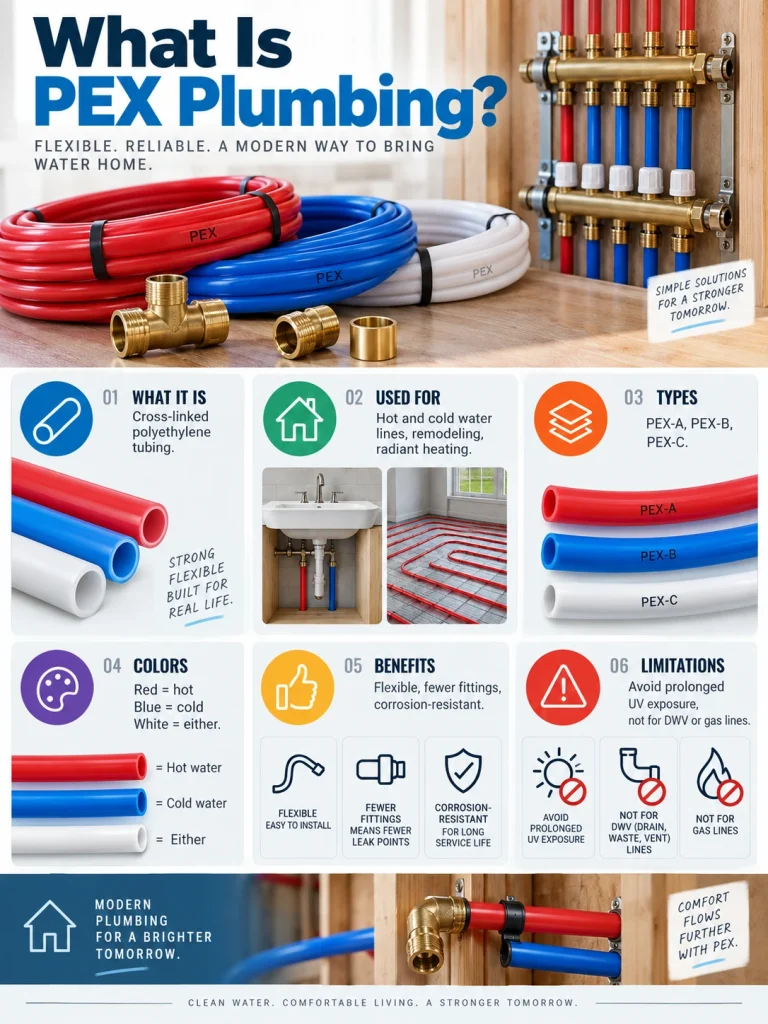
PEX is commonly grouped into three types according to the manufacturing method:
- PEX-A is produced using the peroxide method.
- PEX-B is made through the silane or moisture-cure method.
- PEX-C uses electron-beam processing.
These letters describe how the material was cross-linked; they are not simple quality grades. PEX-A is generally the most flexible, while PEX-B tends to be somewhat stiffer. The appropriate choice depends on the installation method, required fittings, manufacturer’s system, and project specifications.
Fittings and tools are not automatically interchangeable between every PEX product. A connection must be approved for the specific tubing and installed according to the manufacturer’s instructions.
Does the Color Change the Material?
Red, blue, and white PEX are usually made from the same basic material. Color mainly helps installers distinguish hot- and cold-water lines. Red commonly identifies hot water, blue is often used for cold water, and white may be used for either.
Color alone does not confirm where tubing can be installed. Always check the printed markings and product documentation.
Where Is PEX Plumbing Used?
PEX is primarily associated with pressurized water distribution. Depending on the product and local requirements, it may be used in new construction, renovation work, fixture replacements, and heating systems.
Hot and Cold Water Lines
One of the most common uses is distributing potable water from a main line or manifold to individual fixtures. PEX may serve bathrooms, kitchens, laundry areas, and utility rooms.
A traditional trunk-and-branch layout uses a larger main line with smaller branches leading to fixtures. A manifold system gives individual fixtures their own PEX runs from a central distribution point. The best arrangement depends on the building, available space, and expected water demand.
Tubing used for drinking water must be listed and certified for potable-water contact. The Plastic Pipe Institute identifies ASTM F876 and NSF/ANSI/CAN 61 among the important standards associated with PEX potable-water systems.
Remodeling and Repiping
PEX is often considered for remodeling because its flexibility can make it easier to route through joist spaces, wall cavities, and other confined areas. Long continuous runs may reduce the number of connections concealed behind finished surfaces.
This does not mean PEX can simply be pulled through any available opening. The tubing must be supported correctly and protected from sharp edges, screws, nails, excessive bending, and contact with incompatible materials.
Transitions between PEX and existing copper or other piping require approved adapters. Mixing unrelated tubing, fittings, rings, and tools can produce unreliable connections.
Radiant Floor and Hydronic Heating
Certain PEX products are designed for radiant floor heating and other hydronic systems. Warm water circulates through tubing installed beneath or within the floor, allowing the floor surface to release heat into the room.
Heating applications often require oxygen-barrier PEX to limit oxygen from entering the closed system and affecting metal components. Standard potable-water PEX should not be substituted unless it is specifically approved for the intended heating application.
Where PEX Should Not Be Used
PEX has clear limitations. It is not designed to replace drain, waste, or vent piping, and ordinary water-distribution PEX should not be used for gas lines.
The material should also be protected from prolonged sunlight. Ultraviolet exposure can damage the tubing, so it should not be stored outdoors longer than the manufacturer permits or installed where it remains exposed to daylight unless specifically approved.
PEX must be kept away from surfaces or equipment that exceed its temperature rating. Connections near water heaters, boilers, flues, and other heat sources must follow the appliance instructions and applicable plumbing code.
It is also unsuitable where the tubing would remain exposed to physical damage. Protective plates or sleeves may be needed where lines pass through framing or other vulnerable areas.
How PEX Connections Are Made
PEX systems use mechanical connections rather than soldered joints. Depending on the product, a plumber may use crimp rings, stainless-steel clamps, cold-expansion fittings, or approved push-to-connect fittings.
Each method requires compatible components and the correct installation tools. A fitting that appears secure may still leak if the tubing was cut unevenly, inserted incorrectly, expanded improperly, or joined with the wrong ring.
Completed piping should be pressure-tested before walls or ceilings are closed. This allows faulty joints to be found while the system is still accessible.
Is PEX Right for a New York Property?
PEX can be practical, but its use must be evaluated for the specific building. New York City requirements may vary according to the application, building type, location of the piping, and materials involved. A product that is accepted for one project may not be appropriate for another.
This is particularly important in apartment buildings and commercial properties, where fire-resistance requirements, shared systems, pressure zones, and access conditions may affect material selection. Plumbing work may also require permits and installation by a licensed professional.
A plumber should check the current code, product listing, and manufacturer’s instructions before recommending PEX. Existing copper or other piping does not necessarily need to be completely replaced; in some cases, a properly planned partial repair or transition is more practical.
PEX, Copper, or Another Material?
PEX is flexible, resistant to internal corrosion, and does not require a flame for joining. Copper is rigid, handles ultraviolet exposure differently, and may be preferred or required in certain locations. CPVC and other approved materials have their own uses and limitations.
The best choice depends on water temperature, pressure, pipe location, accessibility, local requirements, and the condition of the existing system. Material cost alone should not determine the decision.
If you are researching what is PEX plumbing because you are planning a repair or repiping project, contact Riteway Plumbing for professional plumbing service in New York. A plumber can inspect the existing lines, confirm whether PEX is permitted for the project, and recommend a system suited to the property.